
New Report: Heavy Reliance on Natural Gas and Rapid Growth in LNG Exports Will Drive Electricity Costs Higher for Florida Consumers
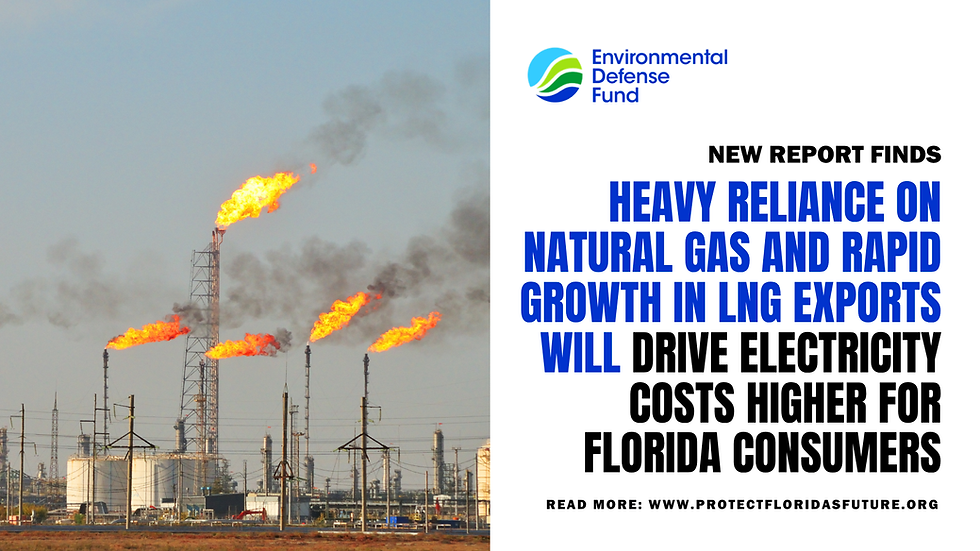
A new report released today finds that Florida’s heavy reliance on natural gas for electricity generation, combined with a surge in U.S. liquefied natural gas (LNG) exports, could expose Florida households to significantly higher and more volatile electricity costs over the next decade.
The analysis highlights that Florida’s three largest investor-owned utilities (IOUs) who serve an overwhelming majority of the state’s energy customers remain deeply dependent on natural gas, with this trend now expected to increase over the next ten years. At the same time, the U.S. is rapidly expanding exportation of LNG. Exported gas is predicted to be 25–30% of domestic natural gas usage by the end of the decade, increasing competition for a finite U.S. gas supply. The report unpacks how this new demand may exacerbate electricity cost increases in Florida.
“Florida families bear the brunt of natural gas overreliance because utilities pass all fuel costs directly to customers,” said Dawn Shirreffs, Florida Director of the Environmental Defense Fund. “When prices swing in the global natural gas market, any increase in natural gas costs shows up directly on our electric bills.”
Key Findings
Near-total reliance on imports: Florida imports more than 99.9% of its natural gas, with the electric power sector accounting for 86% of that demand in 2025.
New proposals increase dependence: Last year, Florida’s investor-owned utilities (IOUs) projected an 18% decrease in natural gas use over the next decade. Their new 2026 plans have reversed course, forecasting a 1.9% increase that deepens fuel dependency and heightens long-term risk.
Consumer exposure to cost: Florida electricity customers bear 100% of fuel cost risk due to pass-through charges on their electric bills.
Rising global demand pressure: U.S. LNG exports are expected to grow substantially, with export volumes projected to triple by 2035.
Higher-priced global markets: In 2024, LNG export prices averaged nearly three times higher than U.S. benchmark prices, as foreign markets set the price for LNG.
Increased volatility: LNG exports—often locked into long-term contracts—are less responsive to domestic price signals. This means exports may continue even during supply constraints, thereby increasing price volatility for U.S. consumers.
As global demand for U.S. LNG increases, the report finds that Florida households could see electricity price increases nearly four times higher than baseline projections by 2035, layering additional monthly costs on top of already rising electric bills. Between 2026 and 2035, Florida households could see another $18.5 billion on their bills due to LNG export growth.
The report emphasizes that diversifying Florida’s energy mix through investment in lower-cost, local energy resources like solar can help reduce exposure to global fuel markets and stabilize long-term electricity costs.
“Diversifying how Florida generates electricity isn’t just about energy security, but also about protecting household budgets,” said David Cranston, Florida Energy Policy Manager at the Environmental Defense Fund. “Expanding lower-cost resources like solar can provide a hedge against natural gas fuel price volatility and help create a more stable, predictable energy future for the state.”
The report also notes that impacts will vary by utility depending on their level of reliance on natural gas, underscoring the importance of long-term planning decisions being made today.


Comments